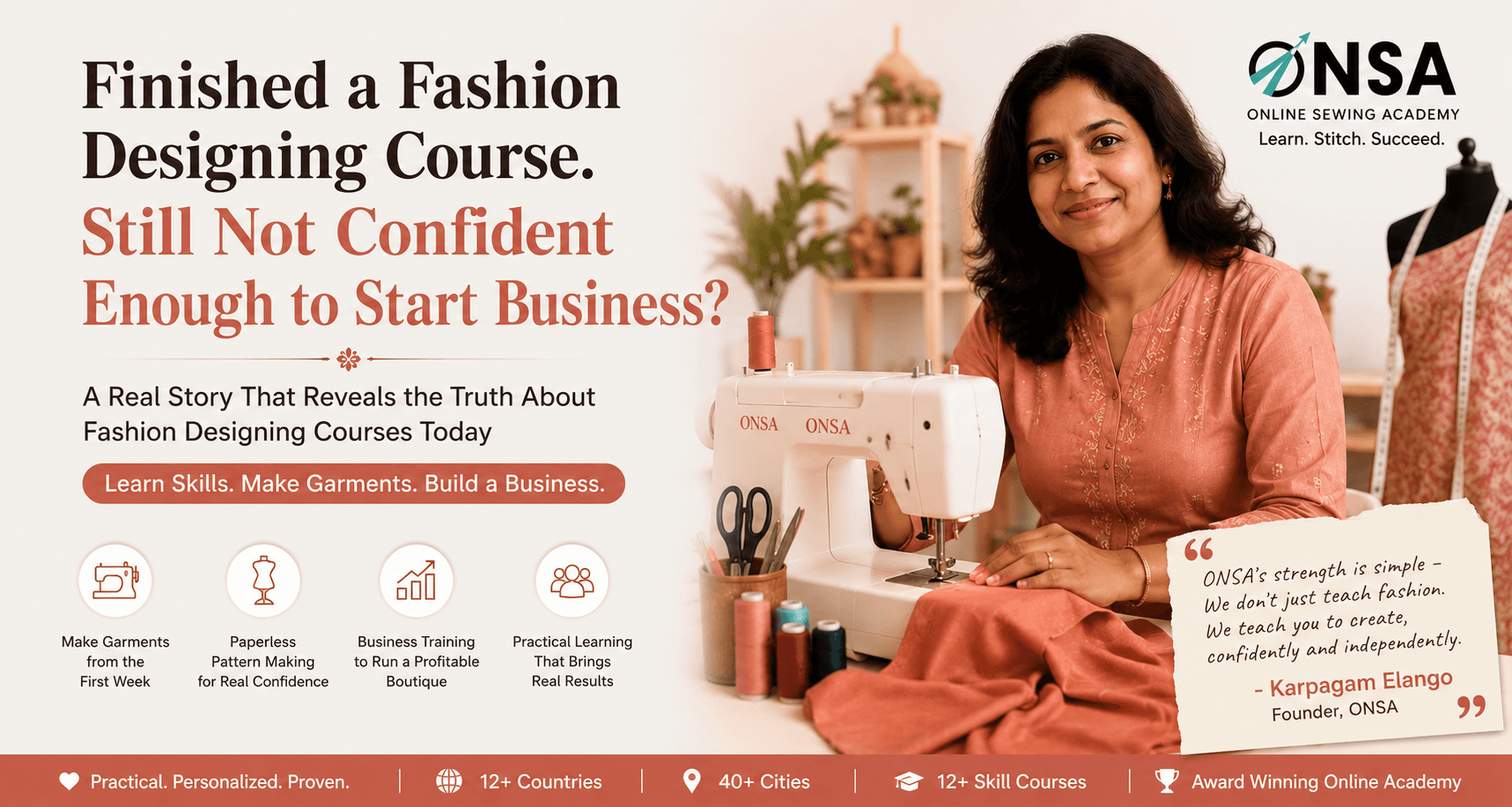
The Phone Call I Received
Recently, I received a call from a lady who had joined a one-year fashion designing course because she wanted to start her own boutique.
She had already been learning for almost 10 months.
When I spoke to her, I was surprised by one thing. She had not yet made even one complete garment by herself.
She had studied pattern making. She had learned about textiles and fabrics. She had worked on motifs and illustrations. She had covered many topics that sound very impressive when we say them as part of a fashion designing syllabus.
But she had not reached the most important point for her goal: making a real garment.
Her goal was not to become a fashion theory student.
Her goal was to start a boutique.
This Is Where I Believe We Need to Rethink the Meaning of "Fashion Designing Course"
When someone tells me, "I want to learn fashion designing," I don't immediately ask how much theory they want to study.
I ask, "What do you want to do after learning?"
If the answer is, "I want to start my boutique," then the learning journey should be designed around that goal.
A boutique owner needs to understand design, fabric, fitting, garment construction, finishing, client requirements, costing, pricing, production and business.
Learning individual subjects is useful. But learning many subjects without connecting them to the final outcome can leave a student feeling educated, yet still unable to make the product she wants to sell. That is the gap I keep seeing.
A Certificate Is Not the Same as Capability
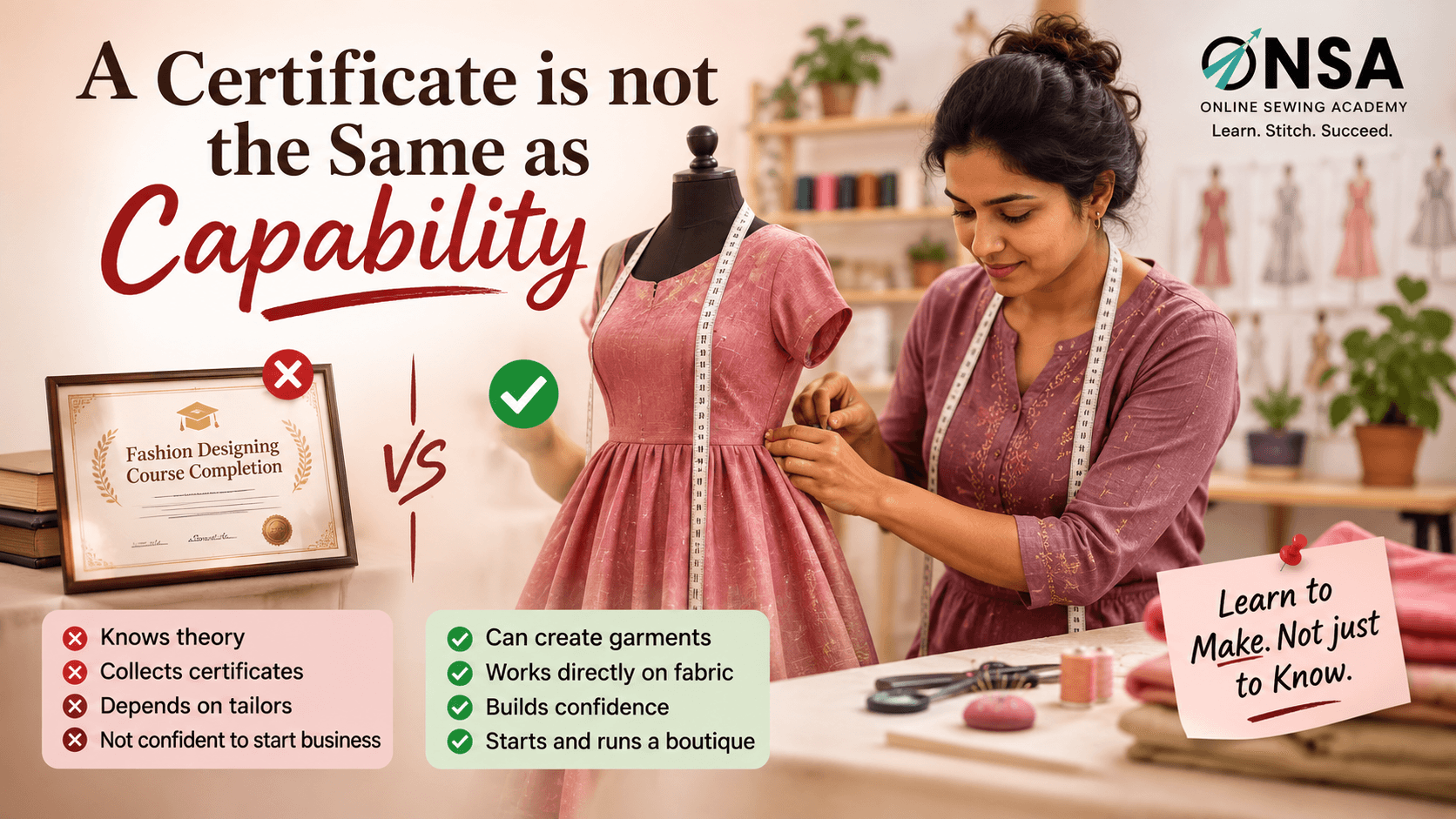
This is something I want every aspiring fashion entrepreneur to understand. Completing a fashion designing course does not automatically mean you can design and make a garment.
I have personally come across students who have completed fashion designing programmes but still depend on a tailor even to make a sample garment for their portfolio. In fact, we have had situations where garments were stitched for fashion designing college students for their portfolio work.
There is nothing wrong with working with a skilled tailor. A good boutique owner will eventually build a team and delegate work. But there is a big difference between delegating work because your business has grown, and depending on someone because you yourself don't know how the garment is made.
For a boutique owner, practical garment knowledge gives you confidence, better quality control, and the ability to communicate clearly with your team and customers.
At ONSA, We Want Students to Make From the Beginning
At ONSA, our approach is very different. Our students start making garments from the first week.
Why? Because making is where confidence comes from. When you cut the fabric, stitch it, see the garment take shape, find a mistake, correct it, and finally wear or see the finished garment — something changes inside you.
You start thinking like a maker.
You stop being afraid of the fabric.
You understand what measurements actually mean.
You understand fitting. You understand construction.
And slowly, you begin to believe, "Yes, I can make this."
That confidence is extremely important when your dream is to start a boutique.
Do You Really Need a Paper Pattern for Every Garment?
Another area where I strongly believe students need to understand the difference between industrial garment production and boutique work is paper pattern making.
I am not saying paper patterns are useless. They are extremely important in the right context. In garment industries, pattern blocks and paper patterns play an important role when the same garment has to be produced in large quantities, with systematic size variations and production controls.
But think about a boutique. A boutique may receive one customer who wants a particular neckline, another who wants a different sleeve, another who wants a different length, and another who wants a completely different style. You are creating customised garments for different people.
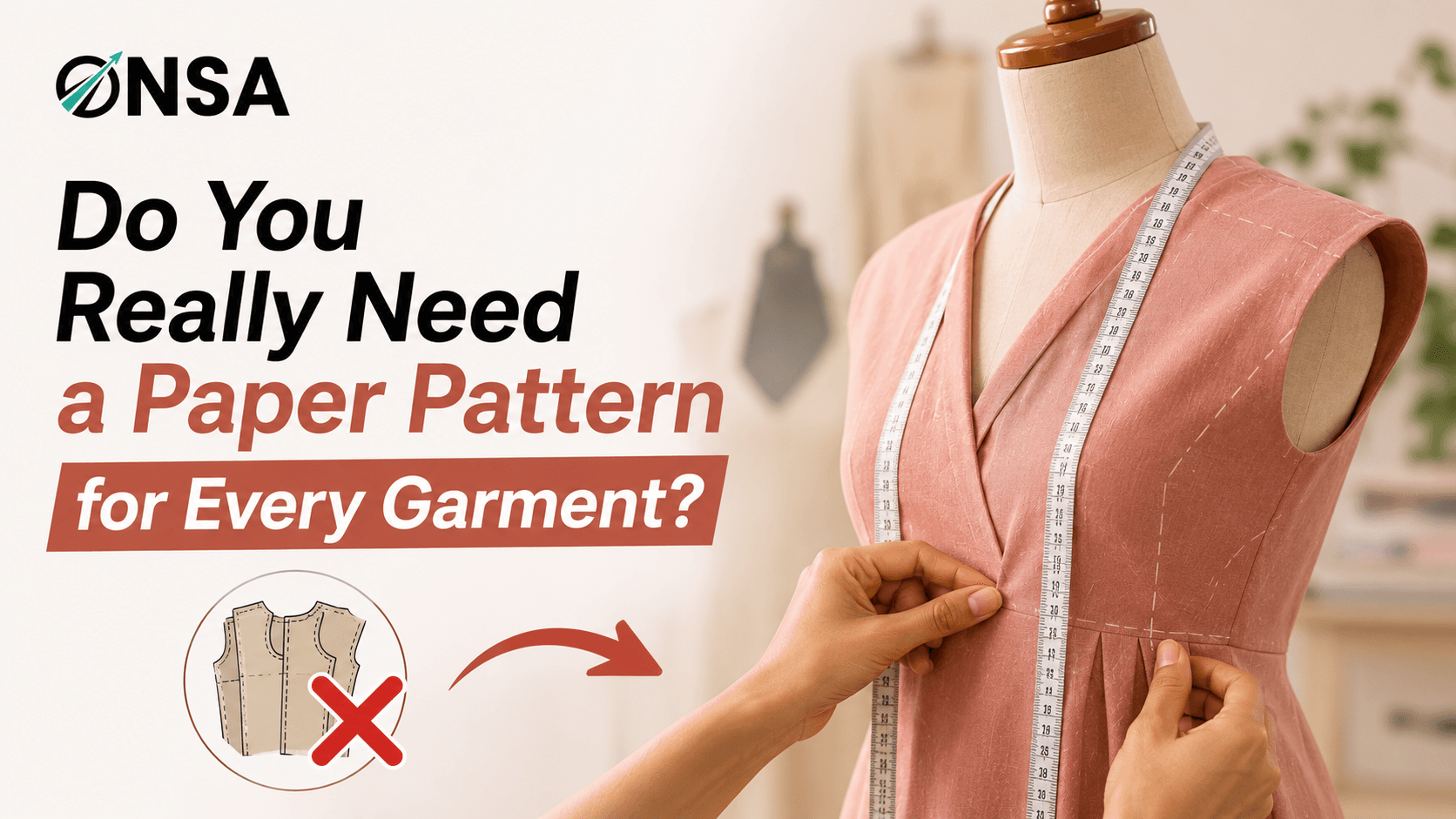
For a large percentage of Indian boutique garments, you can work directly on fabric instead of creating a separate paper pattern every time. This is what we teach through paperless pattern making at ONSA.
The purpose is not to say that paper patterns are bad. The purpose is to teach students to understand when they actually need them and when they don't. Why create unnecessary paper work when you can confidently work directly on the fabric?
Less paper. Less waste. Less confusion. More practice. More confidence.
The Problem Is Not Learning. The Problem Is Learning Without Direction.
There is nothing wrong with learning textiles. There is nothing wrong with learning fashion illustration. There is nothing wrong with learning motifs, theory or detailed pattern making. All of these can have value.
The real question is: are you learning them in the right order and for the right purpose?
If your dream is to become an industrial pattern maker, your learning path will be different.
If your dream is to become a fashion illustrator, your learning path will be different.
If your dream is to work in a garment factory, your learning path will be different.
But if your dream is to open a boutique and make customised garments for customers, your education should prepare you for that reality.
A Boutique Needs More Than Garment Making
There is one more important point. Knowing how to make a garment is only one part of running a profitable boutique. You also need to know how to turn your skill into a business.
- How much should you charge?
- How do you calculate fabric and material costs?
- How do you price your stitching?
- How do you handle customised orders?
- How do you manage customers?
- How do you avoid underpricing your work?
- How do you build a collection?
- How do you market your boutique?
- How do you manage orders and payments?
- How do you grow from making a few garments at home to building a sustainable business?
These are the questions an aspiring boutique owner should be learning to answer. That is why business training is one of ONSA's strengths.
We don't want our students to simply say, "I completed fashion designing." We want them to say, "I know what I am doing, I can make garments, and I know how to turn my skill into an income."

Before You Join a Fashion Designing Course, Ask These Questions
If you are planning to join a fashion designing course, don't choose only by looking at the number of subjects in the syllabus. Ask:
- Will I actually make garments during the course?
- How early will I start practical garment making?
- Will I learn garment construction properly?
- Will I understand fitting and finishing?
- Will I learn how to work with different fabrics?
- Will I learn methods suitable for customised boutique garments?
- Will I learn how to calculate costing and pricing?
- Will I learn how to handle customers and boutique orders?
- Will I learn the business side of fashion?
And most importantly: "At the end of this course, what will I actually be able to do?"
Your Goal Should Decide Your Course
This conversation reminded me of something I have believed for years. Education should take you closer to your goal.
If your goal is a boutique, don't spend months collecting knowledge without developing the ability to make.
If your goal is garment manufacturing, learn industrial methods.
If your goal is fashion illustration, focus on illustration.
If your goal is to become a designer who can actually create garments and build a business, your course needs to bring all these skills together in the right way.
At ONSA, we believe learning should be practical, confidence-building and connected to real life. Our students don't wait until the end of the course to discover whether they can make a garment. They start making from the first week.
Because when a woman tells me, "I want to start my boutique," I don't want to give her only a certificate. I want to help her become capable of building what she dreamed of.
Frequently Asked Questions
What's the real difference between a fashion designing course and a garment construction course?
▼
A fashion designing course, in the formal sense, usually focuses on pattern theory, textiles, motifs and illustration. A garment construction course focuses on actually cutting and stitching real garments. If your goal is to start a boutique, what you need most is construction — the ability to make the product you plan to sell.
Is a fashion designing course necessary to start a boutique?
▼
Not necessarily. What matters for a boutique is being able to make customised garments confidently, price and cost them correctly, and manage customers and orders. That's a mix of practical garment-making and business skills — not the theory-heavy syllabus most fashion designing courses lead with.
Do I need paper pattern making to run a boutique?
▼
For most boutique work, no. Paper pattern blocks matter for garment factories producing the same design across many identical, graded sizes. A boutique making one-off, customised pieces for individual customers can usually work directly on the fabric with the customer's own measurements.
How soon should I be making a real garment in a fashion designing course?
▼
As early as possible — ideally from the first weeks, not after months of theory. If a course pushes hands-on garment making to the final weeks of a long syllabus, ask directly how that timeline serves your actual goal.
A Final Thought From Me
If you are currently learning fashion designing and you have been studying for months but still haven't made a complete garment, please don't feel that you are incapable. Maybe you simply need a different learning approach.
Don't be afraid to ask questions. Don't be impressed only by a long syllabus. Don't choose a course because it sounds advanced.
Choose learning that takes you towards the life and business you actually want.
Because at the end of the day, the real question is not "Did I complete a fashion designing course?" — it's "What can I create because I learned it?" That is where real confidence begins.
— Karpagam Elango, Founder, ONSA | Online Sewing Academy